
I Tested Anthropic's Newly Released Wealth Management Plugin
Anthropic has been making noise in the financial planning space lately. Earlier this week, they released a plugin with a handful of pre-built Claude skills that purportedly handle financial planning tasks. I've been a heavy builder of Gemini Gems and Claude Skills lately, so I was excited to dig into what they published. Here's what's in their GitHub repository:
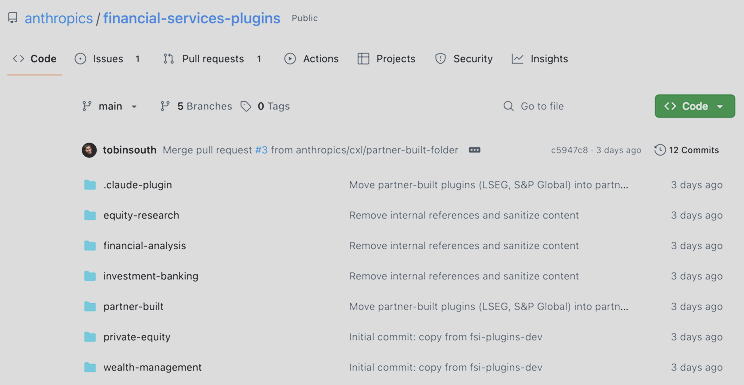
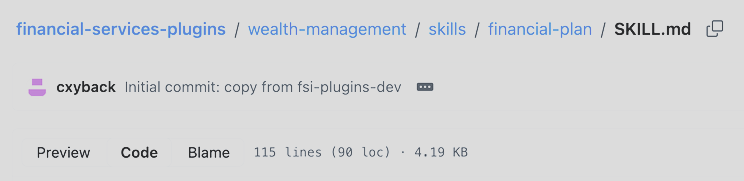
I installed them, then gave the Wealth-Management/Financial-Plan plugin a test drive to see how it compares with one of the gold-standard tools advisors use: RightCapital. I was surprised that the entire instruction set was only 115 lines (643 words). My experience with AI to date tells me complex projects require detailed instructions. I've built Gemini gems for much simpler tasks that required over 2,500 words just to get them remotely trustworthy. After reading the Markdown files, I installed and ran a test using Sonnet-4.6-Extended to address an imaginary couple's needs.
It only asked me five questions, which I answered in 60 seconds. My response was as follows:
Married couple, age 50 and 51. No dependent children.
They want to retire in 5 years. They want to spend $100,000 per year in retirement.
Their current portfolio is worth $2M. They have 401(k), IRA, Roth IRA, and taxable brokerage accounts. They have a 60/40 stock/bond portfolio mix.
Their combined income is $200k/year. They have no other income. Their Social Security estimates at full retirement age are $50,000 in today's dollars, per their Social Security statement.
Their key goals are fully fund retirement without having to go back to work or reduce their spending for their lifetimes to age 95.
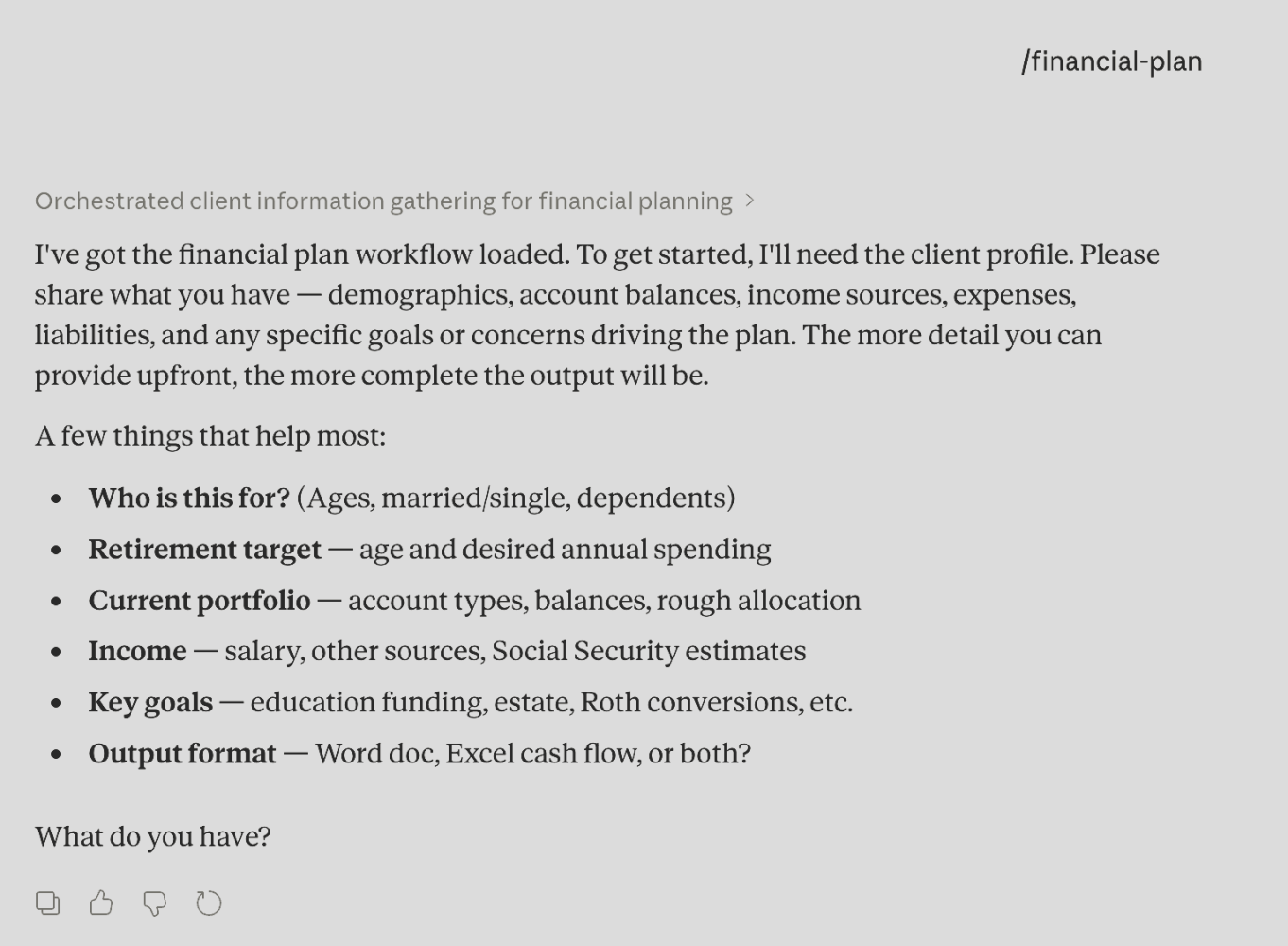
I'm surprised those were the only questions it asked. What about their current savings rate? How much of the portfolio is held in which accounts (for tax reasons)? Will they be comfortable holding a 60/40 portfolio consistently through age 95? Don't you want to know where they live and if they pay state income taxes? What about their risk tolerance and risk capacity - is 60/40 really appropriate? What portfolio mean and standard deviation did it assume for its Monte Carlo simulations?
In any case, the outcome was interesting and directionally accurate, and probably educational to an extent, but not detailed or reliable enough, IMO, to trust with real money. It also didn't show its work, so you'd have to proceed with the assumption it was calculating everything correctly or probe its math more deeply. It claimed to have calculated state and federal taxes somehow without asking what state these people live in. It made a blanket recommendation to hold all equities in taxable accounts and all bonds in tax-deferred accounts, which is a rule of thumb, but not always right.
This aligns with my experience building Claude skills and Gemini gems so far. If you provide extremely detailed instructions and test them thoroughly, it can be quite useful, especially for very specific, well-defined tasks with narrow output ranges where you've provided guardrails and a methodology to follow. But when creating a very complex skill for something as serious as someone's entire financial future, 115 lines of code simply isn't sophisticated enough to be meaningful. If someone created a fully tested Claude skill with 5,000 lines of instructions and guardrails, I might be more curious. These kinds of pre-built AI prompts will become more useful over time, but one still has to know enough to know which questions to ask, how to deliver the right prompts, and how to judge whether what it's telling you is trustworthy. I guess you don't know what you don't know. I suppose the farther someone is from having to make consequential financial decisions, the less risky it is to use AI for these kinds of things. But if someone were trying to decide "can I quit my job and retire next year," it's far too serious a decision to entrust to AI alone.
I'll add a link to a YouTube conversation with Josh Brown on the Prof G Podcast that I think illustrates what I'm saying: "AI is a better complement to experienced workers than it is a replacement." I think we are seeing that in this case too.