
Should We Toss Bonds Overboard?
One of my favorite things is discussing articles that clients send me. One of my clients, who’s plugged into market happenings, sent me a Financial Times opinion piece by pundit and bond expert Bill Gross. It’s behind a paywall, but in short, Gross warns that mounting debt driven by government spending and AI investments threatens long-term economic growth and inflation. He advises investors to avoid bonds entirely, be cautious with stocks, and pivot to short-term Treasury bills or cash.
This is a topic I’ve been thinking about a lot lately, as the bond market took a beating in September and is down over 3% since early July. I guess that doesn’t sound like much given the headlines. My personal portfolio is about 40% bonds, so this matters to me too. Like John Bogle once said, I spend half the time worrying I don’t have enough bonds, and the other half worrying I have too many.
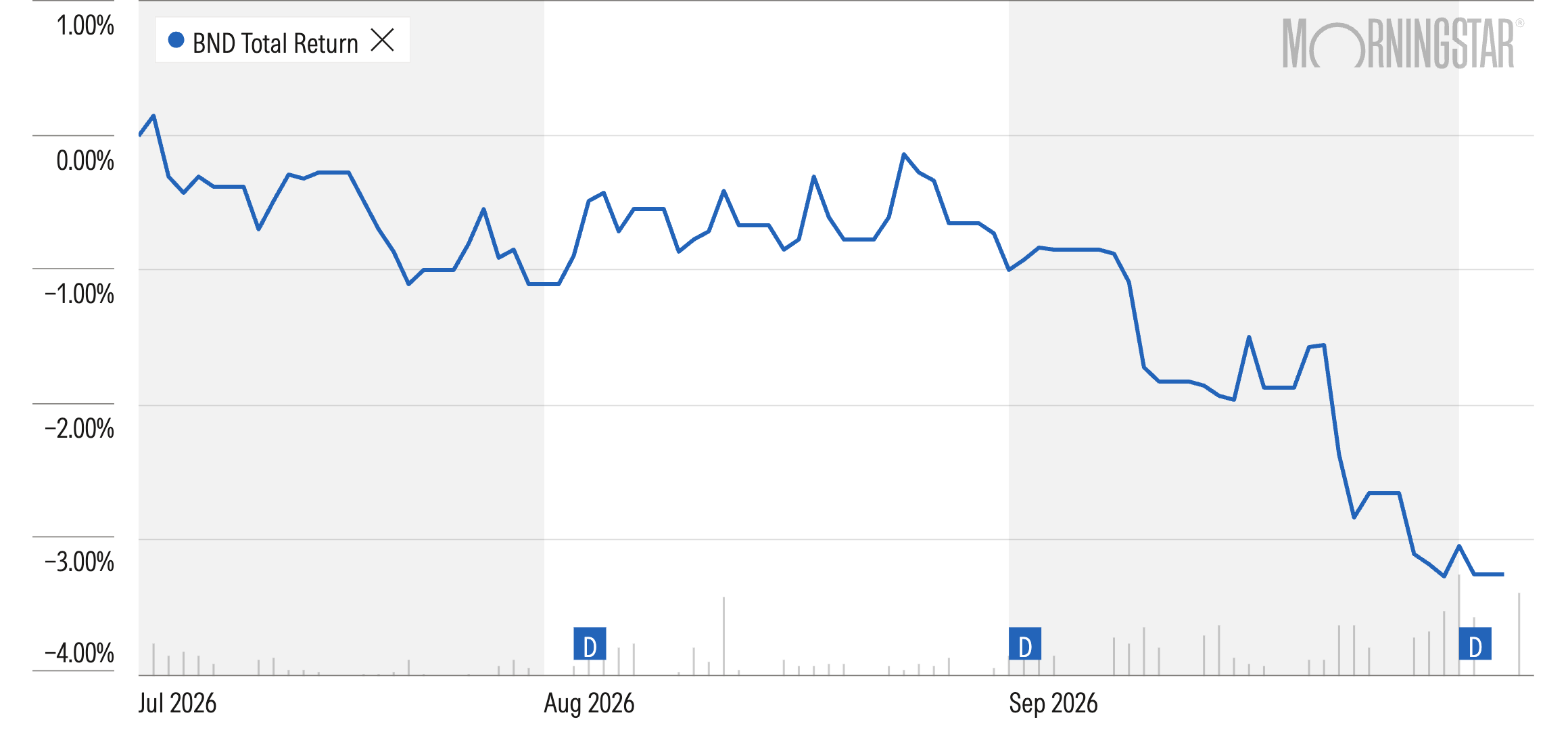
Source: Morningstar.com 10/5/26. BND is the Vanguard Total Bond Market Index Fund
Anyway, here’s what I wrote in response:
It's almost too easy to beat up on bonds these days. Low-hanging fruit. There's a nerdy joke going around... What have we learned about bonds? When stocks go up, bonds go down, and when stocks go down, bonds go down. 🤣
Jokes aside, Bill Gross is a smart guy as the founder of PIMCO, but like every pundit, his opinions aren't universally shared. My personal opinion isn't worth much. I certainly can't predict inflation or interest rates any better than the next guy. The question is, whom should we believe more: one smart guy (Bill) or the entire global debt market with millions of decision-makers all putting their money where their mouth is by pricing in the risks proportionally (i.e. the wisdom of the crowds)? As a side note, the global bond market is bigger than the global stock market... that's a lot of smart people buying bonds.
If Bill had written an Op-ed that said, "There are concerns about debt levels, and that's why bond yields have risen, in proportion, to this concern.", the editors wouldn't have published it. It's too obvious. They needed something more sensational. Bill is a bit like Ray Dalio - a continuous "permabear" macro prophet who's predicted 10 of the last 2 recessions. I guess you don't get invited to keynote at Davos with boring market forecasts.
I had to look this one up, but in early 2011, Bill publicly warned that Treasuries were a terrible investment because the Fed was ending its QE2 program. He completely eliminated them from PIMCO's flagship Total Return Fund, but instead of crashing, they rallied sharply, and yields plummeted to record lows. PIMCO trailed almost all of its peers that year and earned a black eye. Then, starting back in 2010, he declared the end of the decade-long bull market in bonds and told everyone to cut duration (as in this article), but he was too early, and bonds went the other direction. So, while he's sometimes directionally right, his timing has been off. Even a broken clock is right twice a day. It reminds me that John Maynard Keynes once said,
“The market can remain ‘irrational’ longer than you can remain solvent.”
Predicting long-term inflation and interest rates, which is what Bill is doing here, has historically been one of the most impossible tasks in economics. If anyone could do it with even remote accuracy, they'd be wealthier than Elon Musk and certainly wouldn't tell anyone else how to do it! So, while there are definitely risks in the bond market over the next 20 years, I think the market has probably already priced them in.
I think the counterargument to Gross’s article goes like this:
(a) Even with increased volatility, bonds are far more stable than stocks (as measured by their standard deviation). You can lose more in the stock market in a single day than in the bond market in a year. It surprises me that, even though we like to hate on bonds, their long-term Sharpe ratio (volatility-adjusted return) is similar to the stock market. Go figure! Pound for pound, bonds have almost held their own, even with the low yields we've had over the last 20 years and the great bond market massacre in 2022. Yes, bonds have had low returns, but they’ve also been low-volatility.
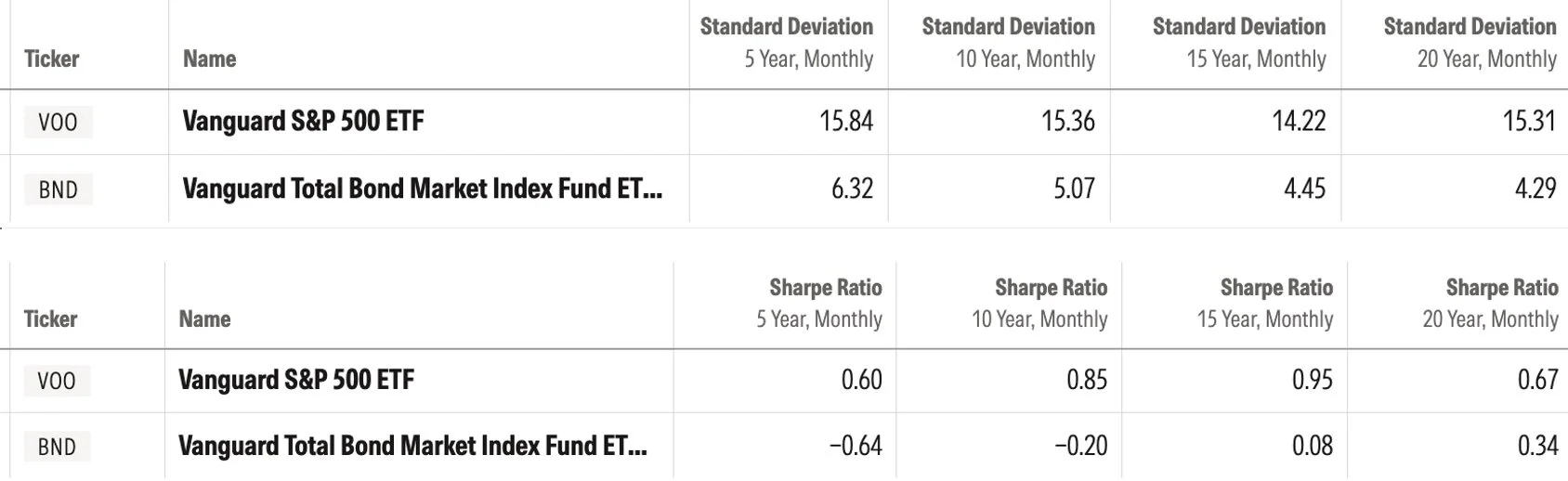
Source: Morningstar.com 10/1/26
(b) Bonds are meant to serve as ballast in a portfolio, keeping up with or slightly beating inflation, but with very low volatility. We add them as an ingredient to prevent sequence-of-returns risk from destroying our retirement nest eggs while we make (or prepare to make) withdrawals for living expenses. So, while they are showing slightly higher volatility now, they are still doing their job. Just don't expect them to match stocks' long-term growth.
(c) If we do what Bill suggests, and move all fixed income holdings into cash or 1-yr treasuries, what happens when those bonds mature next year? Reinvestment risk is real, and yields won't stay this high forever.
(d) Bill suggests moving the stock portion of a portfolio into deep value stocks (think Procter & Gamble), because growth stocks (think Google or Meta) are about to implode. I think that risk is already priced in, and doubling down on value stocks could lead to long-term underperformance. Who is Bill to outguess the $150 trillion stock market?
So, long story short, a balanced portfolio still makes sense to me. I believe markets are, for the most part, efficient, and that risks are usually priced in, in the right proportion, before most of us know what is going on.
The key decision is how much fixed income a portfolio really needs, and whether you can weather a 40% stock market decline and still (1) meet your financial obligations and (2) sleep at night. If not, bonds are on sale, and they're cheaper than at any time in the last 20 years, so that's nothing to sniff at! Stocks and Bonds are weird - unlike other assets, when they go on sale, everyone runs out the door.
Later this week I’ll publish part 2 of this post - my personal manifesto on bonds.